
New study traces African origins of St Helena’s Liberated Africans
Chemical signatures reveal the diverse African origins of people displaced by the transatlantic slave trade.
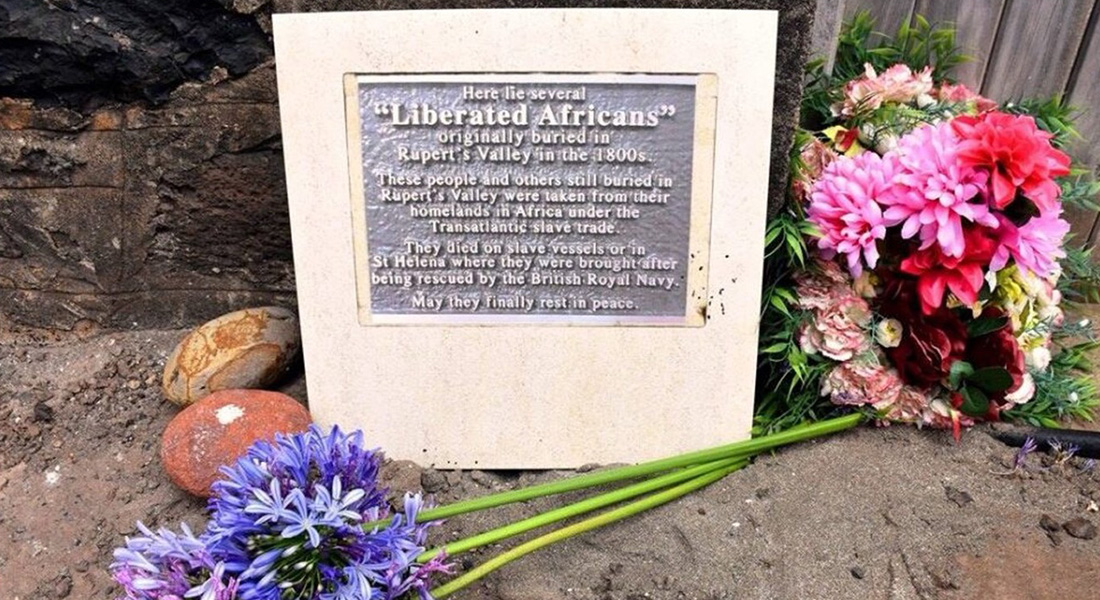
A new interdisciplinary study published in Science has reconstructed the likely childhood origins of 152 Africans who were “liberated” from illegal slave ships and brought to St Helena in the mid-19th century. The research was led by researchers at the Globe Institute, University of Copenhagen, and UC Santa Cruz, working closely with the local community on St Helena.
St Helena is often remembered as the place of Napoleon’s final exile, but it also played a central role in the 19th-century suppression of the transatlantic slave trade. Between 1840 and 1863, nearly 27,000 Africans rescued from illegal slave ships by the British Royal Navy were landed on the island, many of whom died shortly afterwards and were buried there.
Their remains were uncovered during archaeological excavations in Rupert’s Valley in 2007–2008, in connection with construction work for St Helena’s new airport. Since then, discussions on the island have centred on what should happen to the remains, including research, commemoration, reburial and potential repatriation.
As part of this wider community-led effort, the research team used isotope analyses, predictive modelling, ancient DNA and historical evidence to reconstruct the individuals’ likely origins. The results showed that these origins were highly diverse - a finding that contributed to the decision to rebury the remains on St Helena in 2022.
The new work builds on earlier ancient-DNA research, published in 2023, which examined a smaller number of individuals and identified broad links to west-central Africa. The new study analyses more than 150 individuals and adds a different kind of evidence: chemical signatures preserved in teeth, combined with continent-scale predictive modelling.
Chemical signatures of childhood
To investigate where the individuals grew up, the researchers analysed strontium isotope ratios preserved in dental enamel. Tooth enamel forms during childhood and does not remodel later in life, meaning it preserves a chemical signal reflecting the geology of the places where a person lived while growing up.
The team compared these isotope values against a continent-scale “isoscape” - a predictive map of bioavailable strontium isotope variation across sub-Saharan Africa - to identify likely regions of origin.
The isotope results revealed an extremely wide range of values, pointing to highly diverse African origins ranging from coastal and near-coastal regions of western Central Africa to far inland areas, including interior Angola and parts of southeastern Africa.
“Historical records often identify the coastal ports from which slave ships departed, but they rarely tell us where people were taken from inland,” said Hannes Schroeder, Associate Professor at the Globe Institute, University of Copenhagen, who led the study.
“What we see here is a much more complex picture: many individuals likely came from western Central Africa, but others had origins far inland, showing the scale of forced displacement before embarkation.”
Origins far beyond the coast
For some individuals, the most likely regions of origin lay hundreds, and in some cases perhaps thousands, of kilometres from the ports where ships later departed. This suggests that forced displacement often began well before embarkation, with some captives moved over long distances within Africa before reaching the coast.
“One challenge with isotope analysis is that the same strontium value can occur in many different places,” said Xueye Wang from Sichuan University, China, and first author of the study. “Probabilistic spatial modelling helps us deal with that uncertainty by showing where a person’s isotope signature is most likely to fit across the continent.”
The team also analysed paired samples from early- and late-forming teeth in 41 individuals. Several showed changes in isotope values between teeth - and in some cases even within a single tooth - providing evidence for displacement during childhood, likely linked to enslavement.
Science, memory and community
From the outset, the research was shaped by consultation and discussions with the local community on St Helena. These discussions centred on what should happen to the remains, including whether and how they should be studied, how the individuals should be commemorated, and where they should ultimately be reburied.
“This project has always been about more than just the science,” said Helena Bennett, Director of the St Helena National Trust, co-author of the study, and Chair of the Liberated African Advisory Committee, which advises the St Helena Government on matters relating to the Liberated African remains.
“It is about restoring dignity and acknowledging the lives of those who suffered here. The research has helped us better understand where they came from, but it has also highlighted the diversity of their origins. That diversity shaped our discussions about how best to commemorate them, and ultimately informed the decision to reinter the remains on St Helena during a public ceremony in 2022.”
The study does not settle wider ethical or political questions about repatriation. However, it shows why identifying a single place of return is difficult: the individuals came from multiple and sometimes widely separated regions across Africa.
“Science cannot undo the violence of the past,” Schroeder said. “But it can contribute evidence that supports informed, ethically grounded decisions about remembrance, potential repatriation and the reburial of ancestral remains.”
Contact
Hannes Schroeder
Associate Professor
Globe Institute
E-mail: hschroeder@sund.ku.dk
Telephone: +45 42 52 36 14